Overview
Vitamin oral dissolving films (ODFs) uniformly embed vitamins in an edible polymer sheet that melts on the tongue within seconds—no water required. They deliver discreet portability and unit dosing (one strip = one dose) for commuting, meetings, and travel.
Dual-Pathway Mechanism
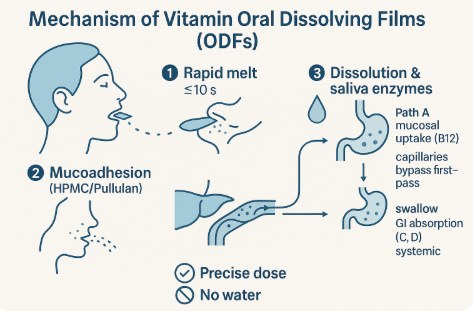
After placement, saliva wets the film and hydrophilic matrices (e.g., HPMC/pullulan/PVA) swell and dissolve, releasing vitamins from the polymer network into the saliva layer. A fraction permeates the sublingual/buccal mucosa, partly bypassing first-pass metabolism for faster perceived onset; the remainder is swallowed and absorbed in the GI tract, yielding a mucosal + GI dual-pathway exposure.
Formulation Orientation by Vitamin Type
Water-soluble vitamins (C, B-complex) disperse readily but require taste masking and buffering for stability and palatability. Fat-soluble vitamins (D3, E, K2) often use emulsified powders, microencapsulation, or solid dispersions to create stable fine dispersions, avoiding oil spots and precipitation.
Key Drivers of Efficiency
Formulation: film thickness (typically 50–120 μm), residual moisture/water activity, micro-pH control, compliant solubilizers (surfactants/cyclodextrins), and flavor system.
Physiology: saliva flow, mucosal integrity, and local perfusion.
Use: place sublingually/buccally and avoid chewing/swallowing until fully dissolved to maximize mucosal contact and user experience.
Quality & Packaging Essentials
Typical release targets: seconds-level dissolution (e.g., ≤10 s), dose uniformity (e.g., CV ≤ ±2–3%), thickness/GSM, residual moisture, and consistent sensory profile. Use high-barrier 4-side-seal or blisters, add desiccants/nitrogen as needed, and validate WVTR/OTR and shipping humidity to prevent deliquescence, curl, and flavor loss.
In One Line
By combining rapid dissolve, mucosal onset, and unit dosing, Vitamin ODFs offer faster perceived effects with portable, compliant supplementation and controllable overall exposure.