
Author: Sihan Meng,Leyu Zhu,Pengcheng Shi
Affiliation: RSBM
Email: pengchengshi@biotechrs.com; pcspc9@gmail.com
Abstract
A true one-stop ODF supplier integrates formulation R&D, precision film manufacturing, and primary packaging into a closed-loop system tied to measurable outcomes. This paper defines what “one-stop” should mean in practice—faster launches, lower total cost, higher OEE, and fewer defects—and offers a methods framework, metrics, and illustrative results comparing one-stop integration with split-vendor or in-house builds. Three figures (a realistic factory photo illustration, an ecosystem flow, and KPI bars) visualize the required capabilities and expected performance deltas. [1–6]
Introduction
ODF programs often stall at the seams: formulation is optimized in one lab, films are cast on a separate line, and packaging specifications are decided later—resulting in drift between CPPs (critical process parameters) and CQAs (critical quality attributes). A one-stop supplier collapses these seams by owning the R2R film line (slot-die/comma, zoned drying, PAT), the slitting and unit-dose packaging, and the recipe and validation playbook across phases. The result: faster tech transfer, stable disintegration and thickness, fewer packaging rejects, and cleaner regulatory files. [2–5]
Methods
Scope definition. Include: (i) Formulation & rheology windows, (ii) Pilot-to-scale coating with zoned drying, (iii) Slitting & unit-dose packaging (sachet/blister), (iv) Inline PAT (thickness, moisture, vision), (v) Validation (FAT/SAT, GR&R, SPC), (vi) Post-launch continuous improvement. [2–4]
Comparators. (a) One-stop (ODM+OEM); (b) Split vendors (separate film and packaging houses); (c) In-house build (new line).
Analytics. Baseline and monitor lead time, cost/1,000 doses, OEE, defect ppm, return rate, and time-to-capacity; correlate upstream CPPs to packaging rejects via PAT timestamps. [3–6]
Measures
Quality & process: thickness CV%, cross-web P–V (µm), disintegration (s), residual moisture (%), seal strength (N/15 mm), Cp/Cpk (≥1.33 preferred).
Operations: OEE (%), good-meters/min, changeover (min), scrap (%), unplanned downtime (h/mo).
Commercial: lead time (weeks to SOP), cost per 1,000 doses (USD), return rate (%), on-time in-full (OTIF, %). [3–6]

Results
Integrated Ecosystem
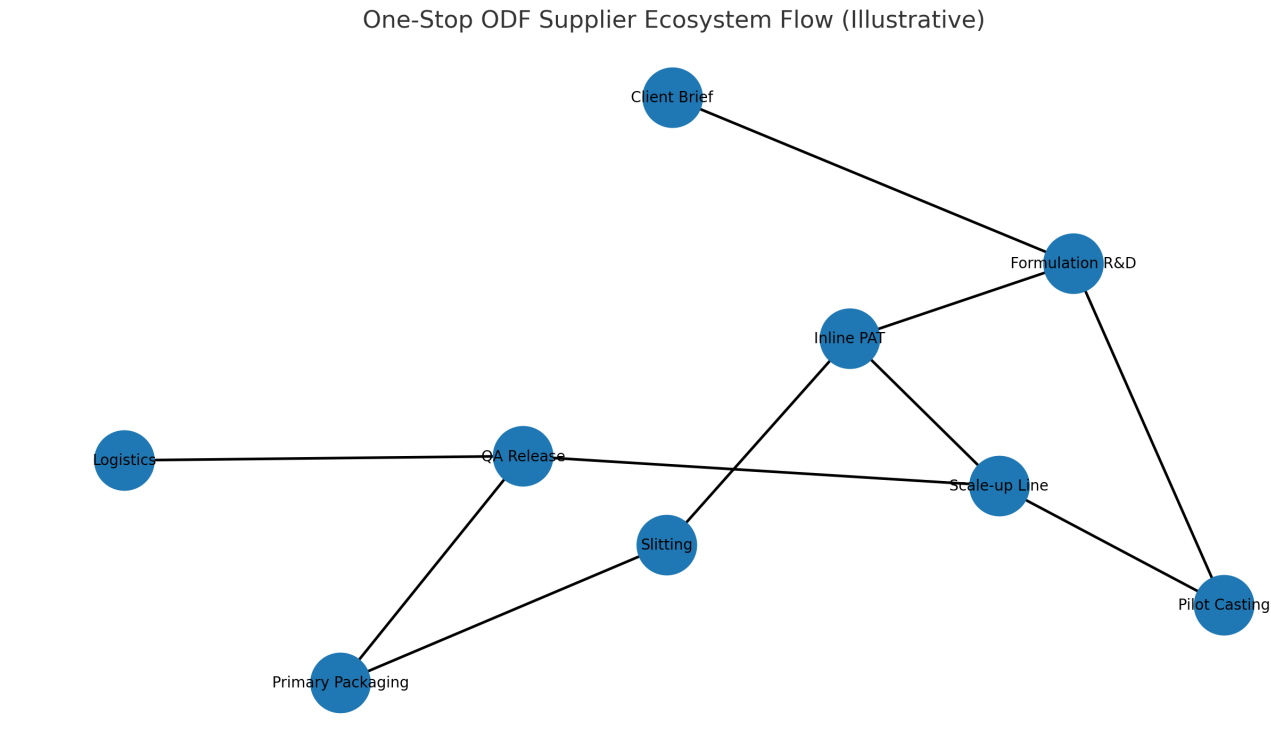
Figure 2 maps the one-stop ecosystem: Client Brief → Formulation R&D → Pilot Casting → Scale-up Line → Inline PAT → Slitting → Primary Packaging → QA Release → Logistics, with feedback from PAT and QA to earlier steps. Tight feedback compresses learning cycles and stabilizes the validated performance window (VPW). [2–5]
KPI Comparison Across Supply Models
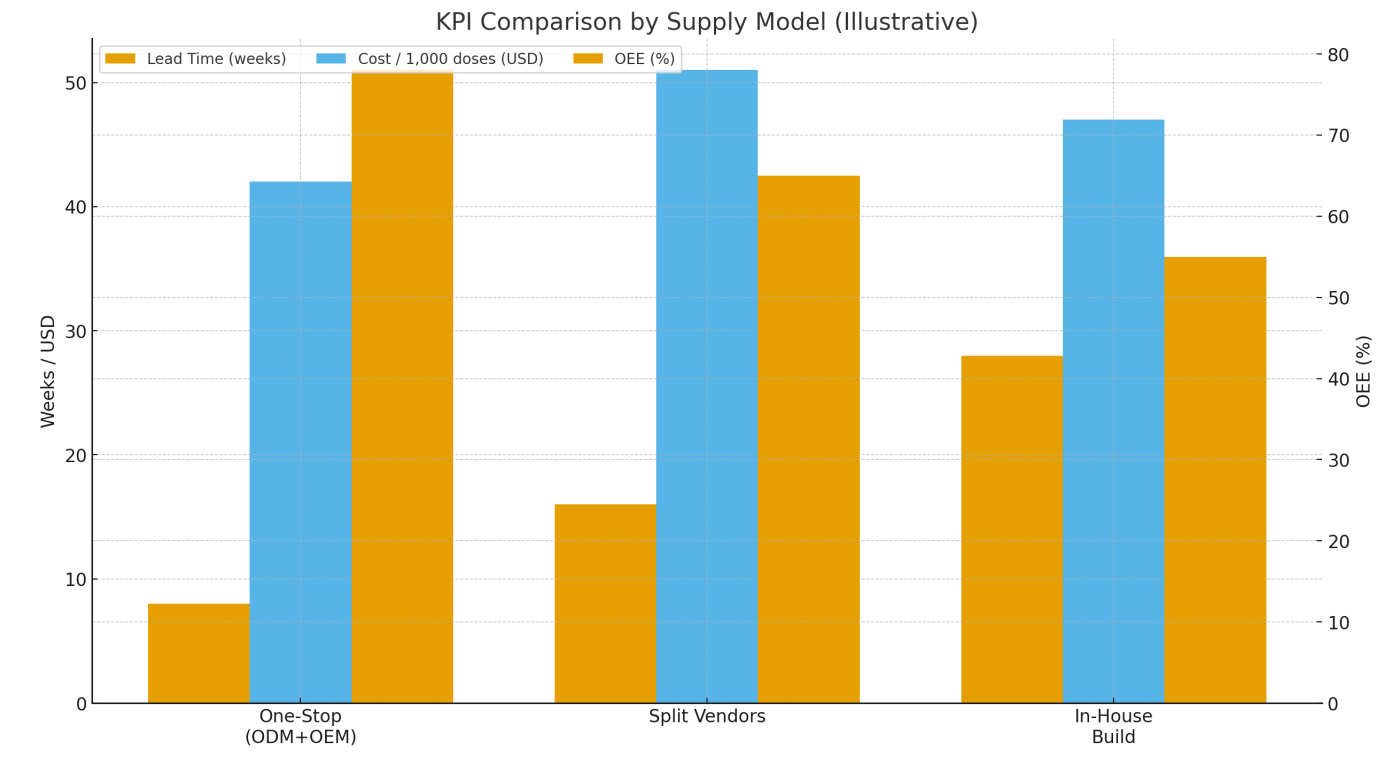
Figure 3 (illustrative) shows the one-stop model reducing lead time (≈8 weeks vs 16–28), lowering cost/1,000 doses, and lifting OEE vs fragmented or greenfield builds. Gains stem from (a) recipe + hardware co-tuning, (b) aligned drying/packaging windows, and (c) single-source PAT and data integrity (ALCOA+) for faster deviation closure. [3–6]
Discussion
Why one-stop wins.
Seamless CPP→CQA control: One owner for rheology, coating gap/speed, zoned drying, and seal windows prevents “throw-over-the-wall” failures.
PAT-driven triage: Thickness/moisture/vision streams map defects to their source—allowing targeted fixes (lip alignment, airflow balance, dwell/temperature).
Faster validation: Single stack handles FAT/SAT, GR&R, SPC, and change-control, cutting documentation handoffs. [2–5]
What to verify in a one-stop partner.
Equipment depth: Slot-die/comma heads, closed-loop tension, multi-zone drying, high-barrier packaging lines.
Metrology: Inline thickness/moisture/vision with proven GR&R and data integrity.
Packaging range: Sachets & blisters, validated peel windows, OTR/WVTR know-how.
Playbooks: DOE-based scale-up guides, recipe libraries, and standard deviation responses (speed/σ/ΔT edits). [3–6]
Risk management.
Dual-sourcing critical laminates, stocking wear parts, and keeping backup recipes for environmental excursions (RH/temperature) protect uptime. For regulatory-sensitive SKUs, ensure audit-ready batch records and change control.
Conclusion
A competent one-stop ODF supplier is not just a contract packer—it is an integrated engineering partner. By unifying formulation, film casting/drying, slitting, packaging, and PAT-anchored validation, the supplier converts nameplate speed into sustained good-meters, lower unit cost, and faster launches—with fewer surprises and cleaner audits.
References
ODF overview and market adoption of unit-dose films—review literature.
Film-forming polymers & plasticizers (HPMC/PVA/pullulan; polyols) and coating rheology implications.
QbD/PAT for thin films: inline thickness, moisture, and vision; data integrity (ALCOA+).
Multi-zone drying, tension control, and cross-web uniformity in R2R coating lines.
Packaging integration for ODFs: seal windows, OTR/WVTR, and easy-open mechanics.
OEE and validation strategies (FAT/SAT, GR&R, SPC) for continuous film operations.