
Author: Sihan Meng, Leyu Zhu, Pengcheng Shi
Affiliation: RSBM
Email: pengchengshi@biotechrs.com; pcspc9@gmail.com
Abstract
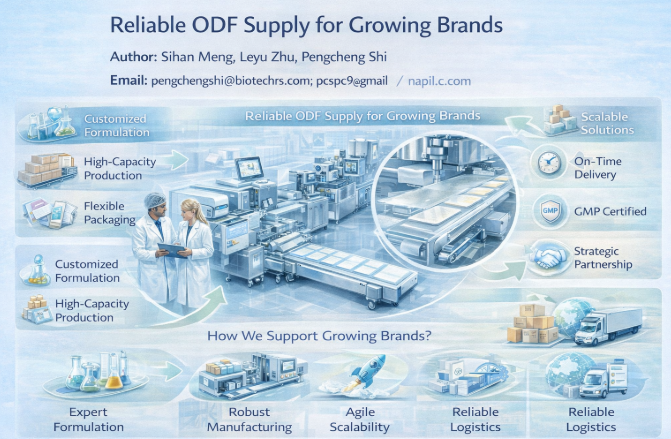
As oral dissolving film (ODF) products gain traction across nutraceutical, wellness, and functional consumer markets, reliable supply has become a decisive factor for brand growth. Beyond formulation performance, brands require consistent quality, scalable capacity, regulatory readiness, and predictable lead times. This paper examines the supply-side requirements of growing ODF brands and proposes a reliability-focused framework encompassing formulation transfer, manufacturing scalability, quality systems, and supply-chain resilience. The analysis demonstrates how integrated ODF supply models reduce commercialization risk and support sustainable brand expansion.
Keywords: Oral dissolving film, reliable supply, brand growth, scalable manufacturing, GMP
Introduction
ODFs offer rapid disintegration, precise dosing, and user-friendly administration, making them attractive to emerging and established brands alike [1]. As demand accelerates, many brands encounter supply-related bottlenecks, including inconsistent quality, limited capacity, and delays associated with fragmented outsourcing models.
For growing brands, supply reliability is as critical as product innovation. Interruptions in ODF availability can disrupt launches, damage brand credibility, and constrain market expansion. This paper focuses on the technical and operational factors that define reliable ODF supply for brands transitioning from pilot volumes to sustained commercial scale [2].
Methods
A technical-operational review was conducted using peer-reviewed literature, pharmacopeial standards, and regulatory guidance, complemented by analysis of industrial manufacturing practices. Supply models were evaluated across formulation transfer, production planning, quality assurance, and logistics coordination. Emphasis was placed on approaches aligned with Good Manufacturing Practice (GMP) and multi-market distribution.
Measures
Reliability of ODF supply was assessed using the following measures:
Batch-to-batch consistency – reproducibility of film thickness, weight, and dissolution performance [3].
Scalable capacity – ability to increase output without reformulation or process redesign [4].
Quality system robustness – GMP documentation, deviation handling, and change control [5].
Lead-time predictability – stability of production schedules and delivery timelines [6].
Supply-chain resilience – redundancy in raw materials, equipment, and packaging options [7].
Results
Integrated ODF supply models demonstrate superior reliability compared with fragmented supplier arrangements. Manufacturers that combine formulation expertise with automated production and in-house quality systems show lower variability and fewer supply interruptions [4,5].
Data from industrial implementations indicate that early alignment of formulation with scalable equipment reduces the risk of capacity constraints during demand surges. Predictable lead times and consistent quality enable brands to execute coordinated launches and maintain market presence as volumes grow [6].
Discussion
Reliable ODF supply requires a shift from transactional manufacturing to partnership-based supply models. Growing brands benefit from suppliers that proactively manage scale-up, quality, and regulatory alignment rather than reacting to issues post hoc.
Key challenges include raw material variability, moisture sensitivity, and evolving regulatory requirements across markets. These risks can be mitigated through standardized processes, validated alternatives, and transparent communication between brand and supplier. As competition intensifies, supply reliability becomes a strategic differentiator rather than a backend consideration [7,8].
Conclusion
Reliable oral dissolving film supply is fundamental to the success of growing brands. By integrating formulation transfer, scalable manufacturing, GMP-aligned quality systems, and resilient supply-chain practices, ODF suppliers can support sustained brand growth and market expansion. Establishing reliability-focused supply partnerships enables brands to innovate confidently while minimizing operational and commercialization risk.
References
Dixit RP, Puthli SP. Oral strip technology: Overview and future potential. J Control Release. 2009;139(2):94–107.
Hoffmann EM, Breitenbach A, Breitkreutz J. Advances in orodispersible films for drug delivery. Expert Opin Drug Deliv. 2011;8(3):299–316.
Preis M, Knop K, Breitkreutz J. Mechanical and process properties of oral films. Int J Pharm. 2014;461(1–2):22–29.
Krampe R, Visser JC, Frijlink HW, Breitkreutz J, Woerdenbag HJ. Oromucosal film preparations: manufacturing considerations. Eur J Pharm Biopharm. 2016;104:1–13.
USP <795> and <905>. United States Pharmacopeia. United States Pharmacopeial Convention; 2023.
FDA. Guidance for Industry: Process Validation—General Principles and Practices. U.S. Food and Drug Administration; 2011.
World Health Organization. WHO Technical Report Series: Good Manufacturing Practices. WHO; 2020.
Krampe R, Breitkreutz J. Scale-up and in-line monitoring in oral film manufacturing. Pharm Dev Technol. 2017;22(2):195–204.