
Author: Sihan Meng, Leyu Zhu, Pengcheng Shi
Affiliation: RSBM
Email: pengchengshi@biotechrs.com; pcspc9@gmail.com
Abstract
In OEM/ODM manufacturing—particularly for Oral Disintegrating Films (ODFs) and other process-sensitive dosage forms—the ability to produce laboratory or pilot samples is often mistaken for readiness for mass production. This misconception leads to failed scale-ups, unstable quality, missed delivery schedules, and elevated total cost. This paper analyzes common OEM misconceptions surrounding sample-making versus industrial manufacturing. By contrasting the technical, operational, and quality-system requirements of sampling and mass production, we identify why many suppliers who can deliver acceptable samples fail at commercial scale. A framework of measurable indicators is proposed to distinguish true mass-production capability from sample-level competence.
Introduction
For brand owners, early-stage OEM selection frequently relies on the ability to produce samples quickly. A successful sample—matching appearance, taste, or basic performance—creates confidence that commercialization is imminent. In reality, sampling and mass production are fundamentally different activities governed by distinct constraints [1].
This gap is especially pronounced in ODF manufacturing, where continuous coating, controlled drying, and precise converting amplify minor instabilities [2]. This paper addresses a recurring industry question: Why do so many OEMs who can “make samples” struggle or fail when orders move to mass production?
Methods
We conducted a comparative analysis of sample-stage and mass-production-stage OEM operations using literature review, manufacturing systems theory, and industrial case experience. Key differences were mapped across formulation robustness, process control, equipment capability, quality systems, and delivery performance. Failure patterns were categorized to identify structural—not incidental—causes [3].
Defining “Sample Capability” vs “Mass Production Capability”
Sample Capability
Sample capability typically includes:
Small-batch formulation preparation
Manual or semi-manual processing
Flexible parameter adjustment
Visual and sensory matching
The primary objective is demonstration, not reproducibility.
Mass Production Capability
Mass production capability requires:
Continuous or semi-continuous operation
Stable process windows
Controlled environments
Validated equipment and procedures
Predictable output over time
The primary objective is consistency at scale [4].
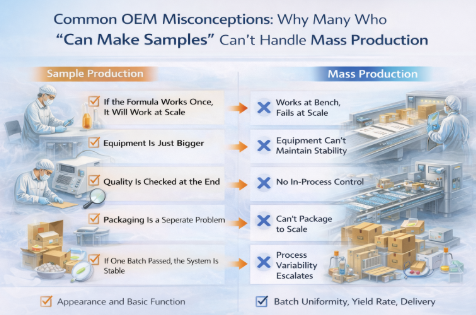
Misconception 1: “If the Formula Works Once, It Will Work at Scale”
In sampling, parameters can be adjusted batch-by-batch. In mass production, parameters must tolerate natural variation in raw materials, environment, and equipment behavior.
Formulations optimized for bench-top success often lack:
Viscosity stability over time
Drying tolerance at higher line speeds
Mechanical robustness for automated cutting
Scale exposes weaknesses that are invisible in one-off samples [5].
Misconception 2: “Equipment Is Just Bigger”
Sample production often uses open, low-speed, manually assisted tools. Mass production relies on continuous, closed systems where:
Coating thickness is area-based
Drying kinetics are tightly coupled to line speed
Minor deviations propagate downstream
OEMs without industrial-grade equipment or experience underestimate how different “bigger machines” truly are [6].
Misconception 3: “Quality Is Checked at the End”
Sample validation is usually end-point based (appearance, taste, basic function). Mass production requires in-process control.
Without defined critical process parameters (CPPs) and critical quality attributes (CQAs), defects accumulate unnoticed until yield collapses during slitting, packaging, or stability testing [7].
Misconception 4: “Packaging Is a Separate Problem”
Many sample-capable OEMs treat packaging as an afterthought. In mass production:
Packaging often sets the true MOQ
Barrier properties determine shelf life
Line speed and sealing windows affect throughput
Ignoring packaging integration is a leading cause of delivery delays and cost overruns [8].
Misconception 5: “If One Batch Passed, the System Is Stable”
Sample success proves possibility, not capability. Mass production demands:
Batch-to-batch consistency
Environmental control (temperature, humidity)
Cleaning validation and cross-contamination prevention
OEMs lacking GMP-style systems often experience escalating variability as volume increases [9].
Measures
True mass-production readiness can be evaluated using the following indicators [10,11]:
First-pass yield at target scale
Thickness and content uniformity across long runs
Process capability indices (where applicable)
Deviation and rework frequency
On-time delivery performance over multiple orders
These measures distinguish structural capability from isolated success.
Results
Across industrial experience, OEMs optimized for sampling show high early responsiveness but poor scalability. OEMs built for mass production may appear slower initially but deliver superior long-term outcomes: stable quality, predictable lead times, and lower total cost of ownership. Transition failures most commonly occur when brands select suppliers based on sample quality alone [12].
Discussion
The persistence of these misconceptions reflects misaligned incentives: samples are evaluated visually and subjectively, while mass production performance is statistical and operational. Bridging this gap requires brands to shift evaluation criteria from “Can you make this?” to “Can you make this the same way, every time, at volume?”
For OEMs, investing in process engineering, quality systems, and production discipline is essential to move beyond sample-level credibility [13].
Conclusion
The ability to produce samples is not evidence of mass-production capability. In ODF and other advanced manufacturing contexts, sample success represents only the first step in a fundamentally different challenge. Brands that recognize and evaluate the structural requirements of mass production—rather than relying on sample performance—avoid costly failures and build more resilient supply chains. OEMs that align their capabilities accordingly become long-term partners rather than short-term solution providers.
References
Fu Y et al. Expert Opin Drug Deliv. 2004;1(4):673–690.
Preis M. J Pharm Pharmacol. 2013;65(2):157–170.
Cilurzo F et al. Eur J Pharm Biopharm. 2008;70(3):895–900.
Dixit RP, Puthli SP. J Control Release. 2009;139(2):94–107.
Morales JO, McConville JT. Ther Deliv. 2011;2(5):637–646.
Hoffmann EM et al. Pharm Res. 2011;28(8):1914–1922.
ICH Q10: Pharmaceutical Quality System.
Borges AF et al. Int J Pharm. 2015;494(1):332–339.
ICH Q7: Good Manufacturing Practice Guide.
USP <701> Disintegration Test.
USP <905> Uniformity of Dosage Units.
Keshari R, Keshari S. J Drug Deliv Ther. 2014;4(4):1–7.
Preis M. Drug Dev Ind Pharm. 2013;39(7):1049–1057.