
Author: Sihan Meng, Leyu Zhu, Pengcheng Shi
Affiliation: RSBM
Email: pengchengshi@biotechrs.com; pcspc9@gmail.com
Abstract
Oral dissolving films (ODFs) have emerged as a versatile dosage form for supplements, nicotine replacement, and selected pharmaceutical applications. However, successful commercialization requires a coordinated design across multiple parameters rather than isolated optimization. This paper presents a comprehensive checklist covering five core dimensions of custom oral film development—flavor, dosage, size, thickness, and packaging. By integrating formulation science, process control, and user compliance considerations, we outline practical decision rules and measurable indicators that can guide developers from concept to scalable production. The aim is to provide a structured, engineering-oriented reference for R&D teams, OEM/ODM manufacturers, and brand owners seeking rapid yet robust product development.
Introduction
Oral dissolving films offer advantages including rapid disintegration, ease of administration without water, and improved portability compared with tablets or gummies. These attributes have driven adoption in nutraceuticals, nicotine delivery, and pediatric or geriatric care [1]. Despite apparent simplicity, ODFs are highly sensitive systems in which taste, mechanical strength, dissolution behavior, and stability are tightly coupled [2].
In practice, development failures often arise because key parameters—such as film thickness or package moisture barrier—are decided independently. This paper reframes ODF development as a checklist-based system, ensuring that critical variables are evaluated together rather than sequentially.
Methods
A structured literature review was conducted focusing on oral film formulation, polymer science, and packaging technology published between 2010 and 2024. Key industrial guidelines and pharmacopeial references were also examined. Based on these sources, a parameter matrix was constructed linking formulation inputs (polymer type, plasticizer level, flavor system) with physical outputs (thickness, tensile strength, disintegration time) and external constraints (dose accuracy, packaging barrier performance). The checklist was iteratively refined using pilot-scale production data reported in the literature [3,4].
Measures
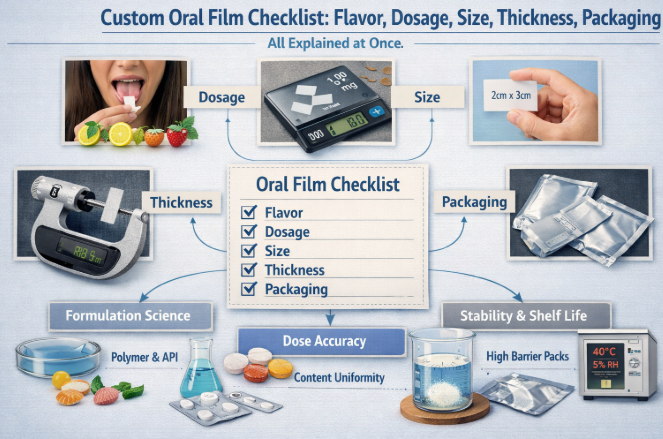
Five primary dimensions were selected as measurable checkpoints:
Flavor performance: sensory acceptability, onset of bitterness, aftertaste duration [5].
Dosage accuracy: content uniformity (%RSD), dose loading per unit area [6].
Size: surface area per strip (cm²) and user handling comfort [7].
Thickness: micrometer-scale uniformity, correlation with tensile strength and disintegration time [8].
Packaging: water vapor transmission rate (WVTR), oxygen transmission rate (OTR), and mechanical protection [9].
Each dimension was evaluated against acceptance ranges reported in peer-reviewed studies and regulatory guidance.
Results
The checklist approach revealed several consistent relationships. Flavor systems were found to interact strongly with dosage density; higher API loading increased bitterness risk and required multilayer or taste-masking strategies [5]. Film size and thickness showed a compensatory relationship: maintaining user-friendly dimensions often required increased thickness to achieve target doses, which in turn affected dissolution time [8]. Packaging emerged as a dominant stability determinant, with high-barrier sachets extending shelf life by more than twofold under accelerated conditions compared with low-barrier pouches [9].
Discussion
Rather than optimizing parameters in isolation, the checklist emphasizes balance. For example, reducing thickness to accelerate disintegration may compromise mechanical integrity unless polymer composition is adjusted simultaneously [2]. Similarly, excellent formulation design can fail commercially if packaging does not adequately control moisture ingress. The checklist therefore functions as a decision-support tool, aligning R&D, manufacturing, and commercialization priorities. This systems-level view is particularly valuable for OEM/ODM projects where rapid iteration is required.
Conclusion
Custom oral film development is best approached as an integrated engineering problem. The proposed checklist—covering flavor, dosage, size, thickness, and packaging—provides a practical framework to reduce trial-and-error, improve scalability, and enhance end-user compliance. By applying measurable criteria across all five dimensions, developers can accelerate time to market while maintaining quality and stability.
References
Preis M, Pein M, Breitkreutz J. Development of a taste-masked orodispersible film containing dimenhydrinate. Pharmaceutics. 2012;4(4):551–562.
Arya A, Chandra A, Sharma V, Pathak K. Fast dissolving oral films: An innovative drug delivery system. Int J ChemTech Res. 2010;2(1):576–583.
Cilurzo F, Cupone IE, Minghetti P, Selmin F, Montanari L. Fast dissolving films made of maltodextrins. Eur J Pharm Biopharm. 2008;70(3):895–900.
Borges AF, Silva C, Coelho JFJ, Simões S. Oral films: Current status and future perspectives. J Control Release. 2015;206:1–19.
Dixit RP, Puthli SP. Oral strip technology: Overview and future potential. J Control Release. 2009;139(2):94–107.
United States Pharmacopeia. USP <905> Uniformity of Dosage Units. USP Convention; 2023.
Hoffmann EM, Breitenbach A, Breitkreutz J. Advances in orodispersible films for drug delivery. Expert Opin Drug Deliv. 2011;8(3):299–316.
Nishimura M, Matsuura K, Tsukioka T, et al. In vitro and in vivo characteristics of rapidly dissolving oral films containing donepezil. Drug Dev Ind Pharm. 2009;35(4):493–500.
Felton LA. Mechanisms of polymer film formation. Int J Pharm. 2013;457(2):423–427.