
Author: Sihan Meng, Leyu Zhu, Pengcheng Shi
Affiliation: RSBM
Email: pengchengshi@biotechrs.com; pcspc9@gmail.com
Abstract
Oral dissolving films (ODFs) have evolved from niche dosage forms into a globally relevant delivery platform spanning pharmaceuticals, nutraceuticals, and consumer health products. As demand accelerates, the primary challenge has shifted from laboratory feasibility to building a supply system that is stable, scalable, and globally deployable. This paper analyzes the key technical, operational, and quality elements required to establish a robust ODF supply chain. By integrating formulation robustness, standardized manufacturing processes, and regulatory-aligned quality systems, a globally scalable ODF supply model can be achieved without compromising performance or consistency.
Introduction
Oral dissolving films offer fast onset, convenient administration, and high patient acceptance, positioning them as a strategic alternative to traditional oral dosage forms. While early research focused on polymer selection and disintegration performance, commercialization has revealed broader challenges related to manufacturing consistency, scale-up, and cross-border supply. Variability in raw materials, environmental sensitivity, and regulatory expectations across regions can undermine reliability if not addressed systematically [1,2]. This paper focuses on supply-oriented considerations that enable ODF production to move from pilot scale to stable, global distribution.
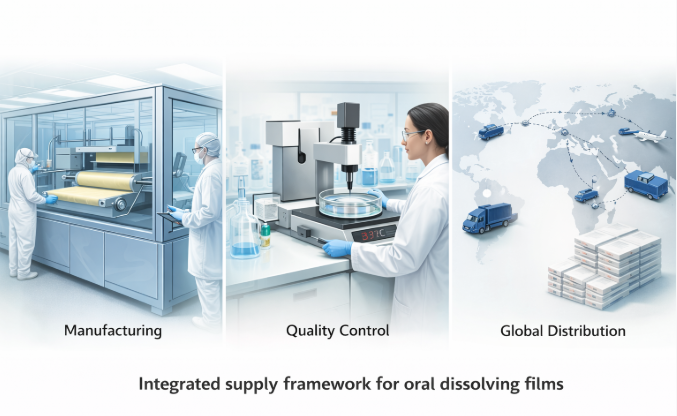
Methods
Supply-Oriented Formulation Design
Formulations were designed with an emphasis on raw material availability, lot-to-lot consistency, and tolerance to process variation. Widely available film-forming polymers with established pharmacopeial status were prioritized to reduce sourcing risk [3].
Manufacturing Process Standardization
Solvent casting, drying, and cutting processes were standardized using defined operating windows for temperature, humidity, and coating thickness. Process parameters were selected to be transferable across production lines and facilities, enabling geographic replication [4].
Quality System Integration
Manufacturing was conducted under GMP-aligned quality systems, incorporating in-process controls, deviation management, and documentation suitable for international audits. This ensured that scalability did not compromise compliance [5].
Measures
Process Capability and Yield
Key performance indicators included batch yield, coating uniformity, and defect rates at increasing production speeds. Statistical process control was applied to assess robustness [6].
Stability and Transport Simulation
Finished films were subjected to accelerated and real-time stability testing, as well as simulated transport stress, to evaluate performance under global distribution conditions [7].
Regulatory Readiness
Documentation completeness, traceability, and alignment with major regulatory frameworks were assessed as part of supply readiness evaluation [8].
Results
Standardized formulations demonstrated consistent performance across multiple production batches and facilities. Process capability indices remained within acceptable ranges as production scaled, and defect rates decreased with increased automation. Stability studies confirmed that properly packaged ODFs maintained mechanical integrity and dissolution performance under a range of climatic conditions. Regulatory documentation was sufficient to support multi-region market entry.
Discussion
A stable and scalable ODF supply chain depends less on achieving extreme formulation performance and more on reproducibility and control. Over-optimization at the laboratory level can reduce tolerance during scale-up, increasing risk. Instead, supply-oriented design emphasizes robustness, standardization, and alignment with global regulatory expectations. These principles allow ODF manufacturers to respond flexibly to regional demand while maintaining consistent quality [9].
Conclusion
Establishing a stable, scalable, and global ODF supply system requires an integrated approach encompassing formulation design, manufacturing standardization, and quality system alignment. When these elements are addressed collectively, oral dissolving films can be produced reliably at commercial scale and supplied across international markets, supporting their continued expansion as a mainstream delivery platform.
References
Dixit RP, Puthli SP. Oral strip technology: Overview and future potential. J Control Release. 2009;139(2):94–107.
Borges AF et al. Oral films: Current status and future perspectives. J Control Release. 2015;206:1–19.
Preis M, Breitkreutz J. Formulation and manufacturing considerations for oral films. Expert Opin Drug Deliv. 2017;14(6):1–12.
Hoffmann EM et al. Manufacturing of orodispersible films: From lab scale to production. Eur J Pharm Biopharm. 2011;78(3):447–455.
World Health Organization. WHO guidelines on good manufacturing practices (GMP).
Montgomery DC. Introduction to Statistical Quality Control. Wiley.
ICH Q1A(R2). Stability Testing of New Drug Substances and Products.
European Medicines Agency. Quality documentation for pharmaceutical products.
Morales JO, McConville JT. Manufacture and characterization of oral films. Eur J Pharm Biopharm. 2011;77(2):187–199.