
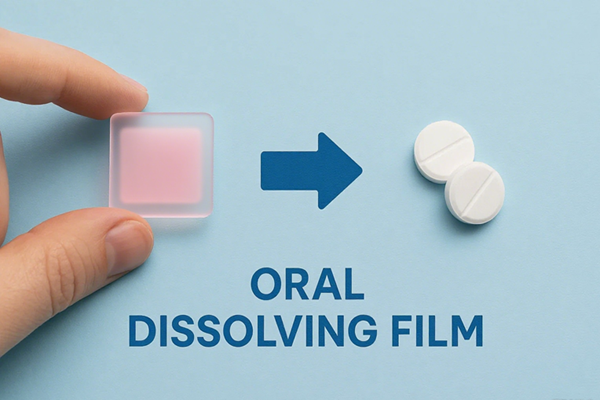
Dosage-Form Advantages
Oral dissolving films (ODFs) enable water-free, rapid dosing that suits pediatrics, geriatrics, and patients with dysphagia. For suitable APIs, partial pre-gastric (buccal/oral mucosal) uptake can reduce GI irritation and potential first-pass exposure. Mass-per-area and cut size are precisely controlled, supporting micro-dosing and segmented dosing. CQAs—content uniformity, disintegration, dissolution, and mechanics—are transparent and controllable, which simplifies bioequivalence, scale-up, and lot release.
Typical Dose
Primarily potent small molecules. Typical per-strip load 1–30 mg; 50–100 mg possible with solid dispersion/lamination (API-dependent). Common sizes 2×3 cm or 3×2 cm; thickness 40–100 μm. Mostly single-dose immediate release; on-demand or multi-strip regimens are feasible when justified.
Common Formulation Challenges (taste/bitterness/disintegration)
Strong bitter/metallic APIs call for β/HP-β-CD inclusion + ion-exchange resinate + micro-coating and a balanced sweet–acid/flavor design. High loads risk grittiness, top-surface enrichment, and slower breakup. Moisture and thickness drift can swing mouthfeel from sticky to brittle and destabilize the disintegration window.
Recommended Strategies & Targets
Use DOE to quantify how polymer/plasticizer/porogen/surfactant/moisture drive CQAs. Targets: 10–30 s disintegration; ≥80–85% 5-min dissolution (method-dependent); CU RSD ≤6%; tensile 10–30 MPa, elongation 30–120%; apparent oral pH 5.5–7.0. Choose high-barrier unit packs (e.g., PET/Al/PE or PA/Al/PE) and verify at 40 °C/75% RH (accelerated). Define a design space and control strategy to de-risk tech transfer and seasonality.