
Author: Sihan Meng,Leyu Zhu,Pengcheng Shi
Affiliation: RSBM
Email: pengchengshi@biotechrs.com; pcspc9@gmail.com
Abstract
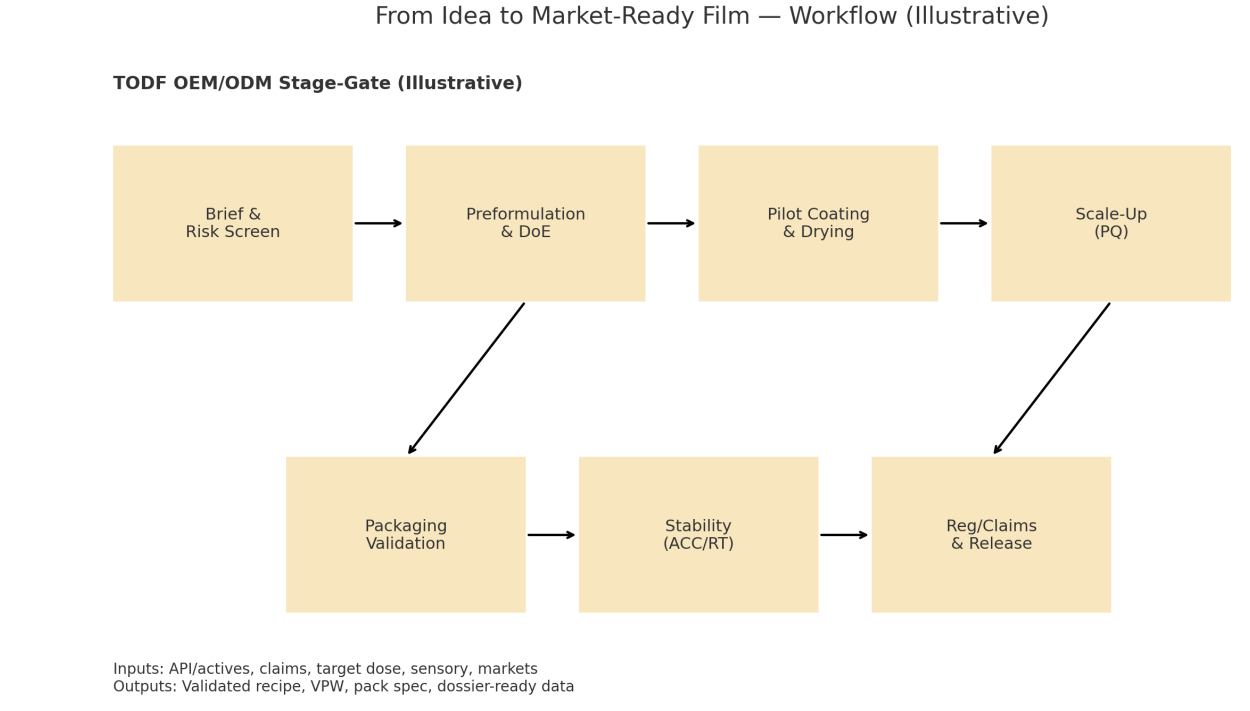
Thin oral dissolving films (TODF/ODF) translate a brief—dose, claims, sensory, and markets—into a validated, pouch-ready product via a disciplined OEM/ODM stage-gate: preformulation and DoE, pilot coating/drying, packaging validation, stability (ACC/RT), and scale-up/PPQ. We present a CPP→CQA framework, practical measures, and outcomes from pilot to commercial capability. Three figures—workflow schematic, overlapped timeline, and capability radar—illustrate how we de-risk launch speed, quality, and cost. [1–9]
Introduction
Brands need a partner that can move from idea to regulated execution without re-learning at each step. Films are sensitive to rheology, coat weight, drying balance, residual moisture, and pouch seal windows; gaps here drive curl, blocking, and non-uniform dose. Our OEM/ODM model integrates formulation science, roll-to-roll engineering, packaging, and quality systems so the first commercial lots are audit-ready. [2–6]
Methods
Brief & risk screen (Gate 0→1).
Inputs: API/actives, target dose, label claims/markets, sensory targets, regulatory pathway. Deliverables: risk register (solubility, taste, dose load), baseline regulatory checklist. [6–9]Preformulation & DoE (Gate 1→2).
Matrix screen (HPMC/PVA/pullulan) and plasticizers; taste-masking options.
DoE on solids %, viscosity law, coat weight, drying ΔT/airflow; map CPP→CQA. [2–5]
Pilot coating & drying (Gate 2→3).
Slot-die/comma trials; inline thickness & moisture PAT; curl/flatness optimization; blocking tests.
Preliminary packaging laminate selection by OTR/WVTR. [3–5,8]
Packaging validation (Gate 3a).
Seal-window study (T/P/dwell), opening-force window, burst/leak; print/vision verification. [5,8]
Stability (ACC/RT) in validated pouches (Gate 3b).
40 °C/75%RH and real-time; assay, moisture, disintegration, sensory hold; shipping simulation. [5,9]
Scale-up & PPQ (Gate 4).
Centerline setting, process capability (Cp/Cpk ≥ 1.33) on thickness/assay; release-by-exception plan; ALCOA+ data integrity. [4–6]
Measures
Film quality: thickness CV%, cross-web P–V (µm), content uniformity RSD%, residual moisture (%), disintegration (s), curl (mm), defect ppm.
Packaging: seal strength (N/15 mm), opening force (N), pouch reject ppm, laminate barrier (OTR/WVTR).
Capability & ops: Cp/Cpk, OEE (%), scrap (%), good-meters/min, changeover (min), OTIF.
Regulatory/data: PPQ completeness, deviation/CAPA closure, GR&R for inline gauges, historian coverage (ALCOA+). [1,4–9]
Results
Stage-gate execution & overlap
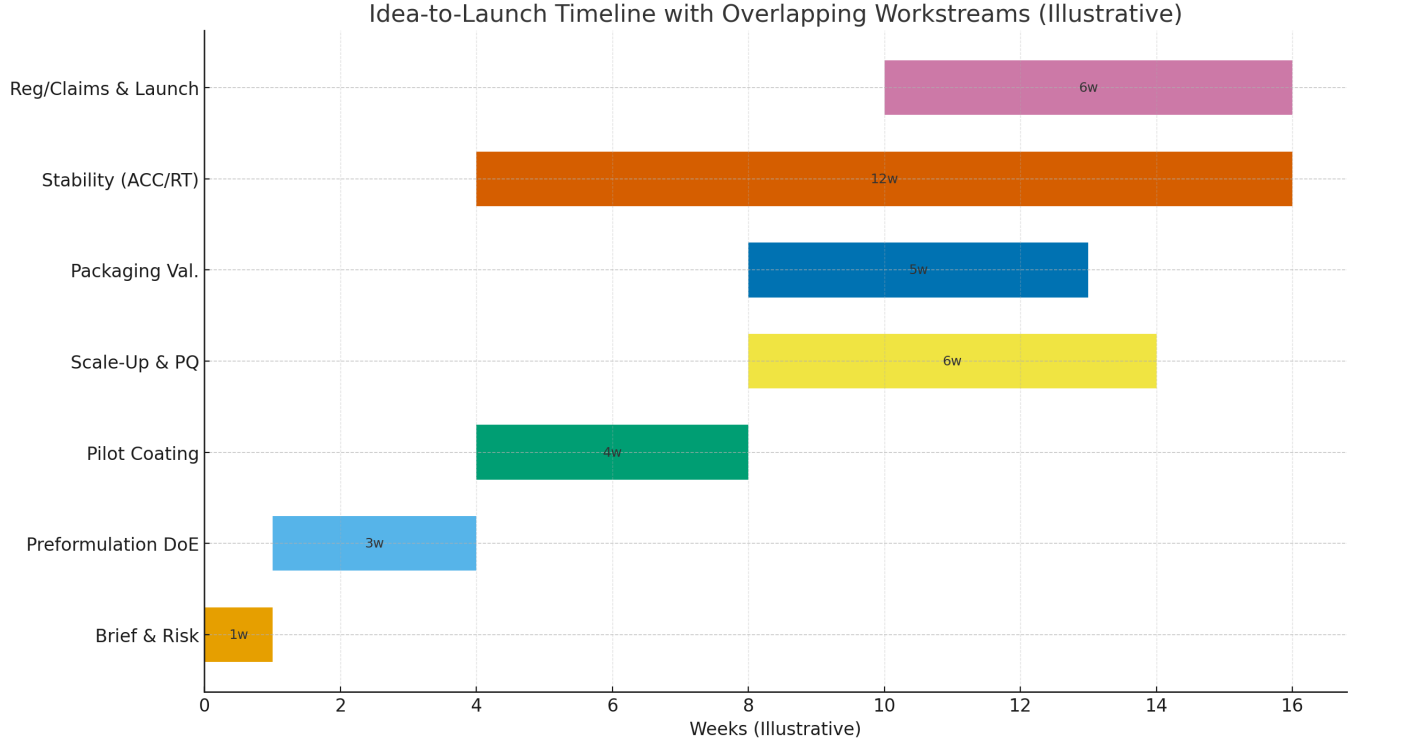
Figure 1 and Figure 2 demonstrate a concurrent plan where packaging validation and stability overlap with pilot/scale-up, shortening time-to-launch without skipping validation depth. [1,6]
Capability lift: pilot → commercial
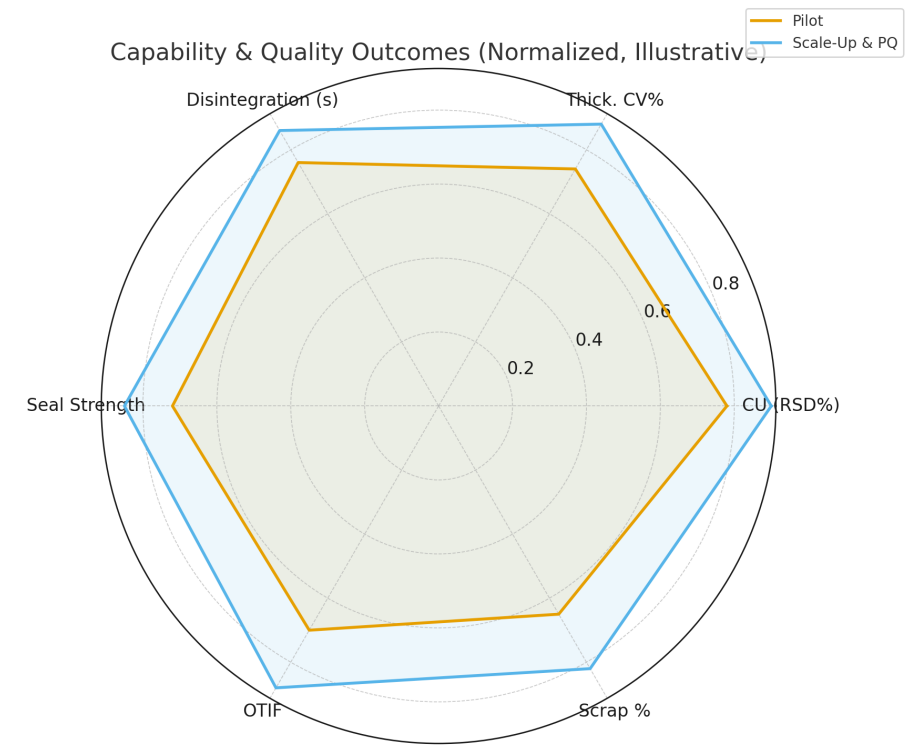
Figure 3 shows normalized KPI improvement from pilot to scale-up/PPQ: tighter content uniformity, lower thickness CV%, faster/consistent disintegration, stronger seal strength with reduced spread, higher OTIF, and lower scrap. Capability uplift is driven by PAT-guided setpoints and verified seal windows. [3–6,8]
Discussion
Why this OEM/ODM model works
Single CPP→CQA thread: every change (solids, die-lip temp, zone air) ties to thickness/moisture/assay and downstream pouchability.
Instrument before speed: align inline–lab bias & GR&R; substitute speculation with SPC/EWMA and historian alarms.
Pack early: laminate choice and seal window are solved alongside drying/curl; moisture spec is co-owned by coating and packaging.
Regulatory readiness: PPQ batch records, CAPA logic, and traceability enable audit-ready launch. [4–8]
Common pitfalls (and our countermeasures)
Chasing dose with wet thickness → (t_{\text{level}}) explosion and curl; we prioritize higher solids % and rheology tuning.
Dryer tuned only by outlet temperature → skin-over; we manage ΔT/airflow and web residence to preserve leveling.
Late packaging validation → seal failures at launch; we run early seal-window and opening-force mapping linked to residual moisture. [2–6,8]
Conclusion
Turning a formula idea into a market-ready film requires synchronized formulation, coating/drying, and packaging—governed by PAT, SPC, and validated windows. The TODF OEM/ODM stage-gate compresses timelines while increasing capability, yielding stable quality, faster launches, and lower total cost-to-serve.
References
Program/portfolio planning and overlapping validation for fast-to-market launches.
ODF polymer matrices (HPMC/PVA/pullulan): rheology, coatability, and mechanics.
Slot-die/comma coating with PAT for thickness/moisture and defect vision.
QbD and process capability (Cp/Cpk, GR&R) for thin-film manufacturing.
Packaging integration: laminate OTR/WVTR, seal-window and opening-force validation.
SPC/EWMA with historian alarms; ALCOA+ data integrity and PPQ documentation.
Taste-masking stacks and sensory validation for consumer acceptance.
Curl/blocking control via drying balance and conditioning RH/time.
Stability protocols (ACC/RT) and shipping simulation for pouch formats.