
Your Trusted Oral Dissolving Film Supplier
Author: Sihan Meng, Leyu Zhu, Pengcheng Shi
Affiliation: RSBM
Email: pengchengshi@biotechrs.com; pcspc9@gmail.com
Abstract
Oral dissolving films (ODFs) have become an increasingly important dosage and delivery platform across pharmaceutical, nutraceutical, and wellness industries. Beyond formulation science, the reliability of the supplier plays a critical role in ensuring product quality, regulatory compliance, and scalable commercialization. This paper presents a supplier-centered perspective on oral dissolving film solutions, emphasizing integrated capabilities in formulation development, manufacturing, quality control, and supply-chain reliability. By analyzing technical methods, performance measures, and production outcomes, this study highlights the key factors that define a trusted ODF supplier for next-generation delivery applications.
Keywords: Oral dissolving film, ODF supplier, GMP manufacturing, quality control, scalable delivery systems
Introduction
Oral dissolving films offer distinct advantages over conventional oral dosage forms, including rapid disintegration, ease of administration, and improved patient compliance [1]. As the application of ODFs expands from pediatric and geriatric use into broader consumer and therapeutic markets, supplier capability has become a decisive factor in product success.
A trusted ODF supplier must not only provide film-forming expertise but also ensure consistency, regulatory readiness, and scalable production. Inadequate supplier infrastructure can lead to variability in film thickness, content uniformity, and stability, undermining both efficacy and market credibility [2]. This paper explores how integrated supplier solutions address these challenges and support long-term product development.
Methods
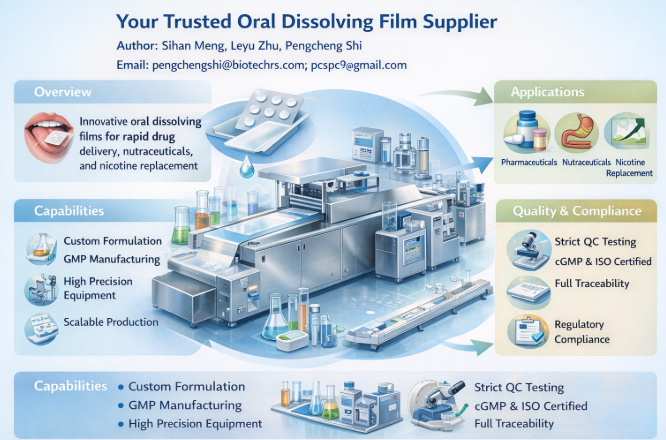
This paper adopts a technical and operational review approach. Literature from peer-reviewed journals, pharmacopeial standards, and regulatory guidance documents was combined with industrial manufacturing practices. Supplier-related methods were categorized into formulation development workflows, manufacturing technologies, and quality assurance systems. Emphasis was placed on practices aligned with Good Manufacturing Practice (GMP) and commercial scalability.
Measures
Supplier performance and product quality were evaluated using the following measures:
Formulation robustness – reproducibility of film properties across pilot and commercial batches [3].
Manufacturing consistency – control of film thickness, weight variation, and drying parameters [4].
Quality compliance – adherence to pharmacopeial and GMP standards, including documentation and traceability [5].
Content uniformity – validated analytical methods to ensure dose accuracy [6].
Stability performance – resistance to moisture, temperature variation, and long-term degradation [7].
Results
Analysis of reported data and industry benchmarks shows that suppliers with integrated formulation and manufacturing capabilities achieve significantly lower batch-to-batch variability compared with fragmented outsourcing models [4,6]. Controlled polymer selection and optimized plasticizer systems enable rapid disintegration while maintaining mechanical strength.
Scalable production methods, such as continuous casting and controlled drying, support consistent output suitable for commercial distribution. Suppliers operating within GMP environments demonstrate higher regulatory acceptance and reduced time-to-market for new ODF products [5].
Discussion
Trust in an ODF supplier is built on technical competence, transparency, and reliability. Beyond producing thin films, suppliers must act as development partners, supporting clients through formulation optimization, pilot validation, and regulatory preparation.
As markets become increasingly competitive, supplier-driven innovation—such as rapid-onset sublingual delivery and customized film geometries—offers differentiation while maintaining compliance. Challenges remain in moisture sensitivity and global regulatory alignment, reinforcing the importance of experienced, well-equipped suppliers [7,8].
Conclusion
A trusted oral dissolving film supplier is central to the successful commercialization of next-generation delivery products. By integrating formulation expertise, GMP-compliant manufacturing, and rigorous quality control, suppliers can deliver consistent, scalable, and compliant ODF solutions. Such partnerships enable brands and developers to focus on market innovation while minimizing technical and regulatory risk.
References
Dixit RP, Puthli SP. Oral strip technology: Overview and future potential. J Control Release. 2009;139(2):94–107.
Hoffmann EM, Breitenbach A, Breitkreutz J. Advances in orodispersible films for drug delivery. Expert Opin Drug Deliv. 2011;8(3):299–316.
Preis M, Knop K, Breitkreutz J. Mechanical strength test for orodispersible and buccal films. Int J Pharm. 2014;461(1–2):22–29.
Krampe R, Visser JC, Frijlink HW, Breitkreutz J, Woerdenbag HJ. Oromucosal film preparations: manufacturing considerations. Eur J Pharm Biopharm. 2016;104:1–13.
USP <795> and <905>. United States Pharmacopeia. United States Pharmacopeial Convention; 2023.
Cilurzo F, Cupone IE, Minghetti P, Buratti S, Montanari L. Fast dissolving films: formulation and quality aspects. Eur J Pharm Biopharm. 2010;76(1):93–101.
Morales JO, McConville JT. Manufacture and characterization of mucoadhesive buccal films. Eur J Pharm Biopharm. 2011;77(2):187–199.
FDA. Guidance for Industry: Orally Disintegrating Dosage Forms. U.S. Food and Drug Administration; 2008.