
Author: Sihan Meng, Leyu Zhu, Pengcheng Shi
Affiliation: RSBM
Email: pengchengshi@biotechrs.com; pcspc9@gmail.com
Abstract
Packaging prototyping is a critical but often underestimated phase in oral dissolving film (ODF) product development. The choice of packaging format—particularly between sachets and blister packs—has a substantial impact on development timelines, cost, and project risk. This paper provides a structured comparison of prototyping timeframes for sachet and blister packaging, analyzing the underlying technical, operational, and regulatory drivers of delay. By breaking down the prototyping process into discrete stages, this study offers realistic expectations for development schedules and practical guidance for aligning packaging decisions with project timelines.
Introduction
In ODF development, formulation and film manufacturing are frequently prioritized, while packaging is treated as a downstream task. In practice, however, packaging prototyping often becomes the critical path that determines time-to-market [1]. Differences in tooling requirements, material qualification, and validation complexity can result in weeks—or even months—of schedule divergence depending on the selected packaging format.
Sachets and blister packs represent two of the most commonly used primary packaging formats for ODFs. Although they may appear functionally similar in early planning stages, their prototyping timelines differ substantially. Understanding these differences is essential for realistic project planning, especially for regulated or time-sensitive launches [2].
Methods
This study used a process-decomposition and comparative analysis approach:
Packaging Process Decomposition
The prototyping workflow was divided into design, material selection, tooling preparation, trial runs, and validation.Format-Specific Mapping
Each step was mapped separately for sachet and blister packaging to identify time-critical differences.Industry Practice Review
Typical lead times were derived from industrial ODF projects across pharmaceutical and nutraceutical sectors.Risk Adjustment Analysis
Time extensions due to rework, failed trials, or regulatory feedback were incorporated into estimated timelines.
Measures
Prototyping duration was evaluated using the following indicators:
Design-to-First-Sample Time: Time required to obtain an initial physical prototype.
Tooling Lead Time: Time needed to prepare format-specific tooling.
Iteration Cycles: Number of design–test–adjust loops typically required.
Validation Readiness Time: Time to reach a packaging configuration suitable for stability testing or regulatory submission.
Total Prototyping Timeline: End-to-end time from concept to approved prototype.
These measures reflect both technical and organizational constraints [3].
Results
Sachet Packaging
Sachet prototyping showed relatively short and predictable timelines.
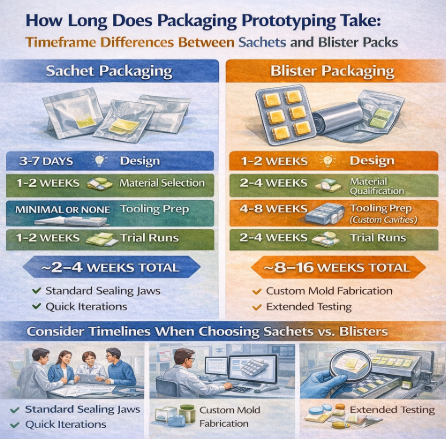
Design Phase: 3–7 days
Material Selection and Sourcing: 1–2 weeks
Tooling Preparation: Minimal or none (standard sealing jaws)
Trial Runs and Iteration: 1–2 weeks
Total Typical Timeline: ~2–4 weeks
The absence of custom cavities or rigid tooling significantly reduced lead times. Most delays arose from laminate selection and sealing parameter optimization.
Blister Packaging
Blister prototyping required substantially longer timelines.
Design Phase: 1–2 weeks
Material Selection and Qualification: 2–4 weeks
Tooling Preparation (Custom Molds/Cavities): 4–8 weeks
Trial Runs and Iteration: 2–4 weeks
Total Typical Timeline: ~8–16 weeks
Custom tooling and tighter dimensional tolerances were the dominant contributors to extended timelines.
Discussion
The results demonstrate that sachet packaging is inherently more agile during early development, making it suitable for pilot studies, market testing, and fast-track launches. Blister packaging, while offering superior dose control and regulatory robustness, introduces significant time overhead due to tooling fabrication and validation requirements [4].
A common project failure mode is committing to blister packaging too early without accounting for tooling lead times. Conversely, delaying blister development until late stages can compress validation schedules and increase regulatory risk. Strategic sequencing—using sachets for early phases and transitioning to blisters in parallel with formulation lock—is often the most time-efficient approach.
Conclusion
Packaging prototyping timelines differ dramatically between sachets and blister packs. Sachets typically reach approved prototype status within weeks, while blister packs may require several months due to tooling and validation complexity. Recognizing these differences early enables more accurate project planning, reduces development risk, and supports timely commercialization. Packaging format selection should therefore be treated as a timeline-critical decision, not merely a cost or preference choice.
References
Borges, A. F., Silva, C., Coelho, J. F. J., & Simões, S. (2015). Oral films: Current status and future perspectives. Journal of Controlled Release, 206, 1–19.
Preis, M., Knop, K., & Breitkreutz, J. (2013). Mechanical strength test for orodispersible films. International Journal of Pharmaceutics, 461(1–2), 22–29.
Dixit, R. P., & Puthli, S. P. (2009). Oral strip technology: Overview and future potential. Journal of Controlled Release, 139(2), 94–107.
Cilurzo, F., Musazzi, U. M., Franzé, S., Selmin, F., & Minghetti, P. (2016). Orodispersible dosage forms: Biopharmaceutical improvements and regulatory requirements. Drug Discovery Today, 21(5), 707–716.